Variations on a torus
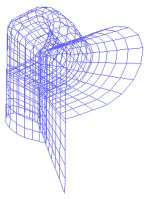
Why should we be content with just a torus in four dimensions (see the discussion of the Mathematicians torus)? After all, we can view a torus as just the Cartesian product of two circles: S x S, where S denotes a circle; we can play the same game with any two figures in the plane. For example, we could consider the Cartesian product of a circle and a square, a line and an oval, or a triangle and a hyperbola.
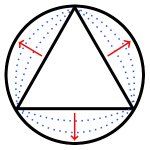 While the Cartesian product of two plane figures will be quantitatively different from the torus S x S, it will not necessarily be qualitatively different. Some figures can be continuously deformed into a circle, and so are not qualitatively different a circle. For instance, we can push out the edges of a triangle onto an enscribing circle (as in the diagram on the right); similarly, a square can also be deformed into a circle. In Mathematics, the adjective homeomorphic is used for objects that are qualitatively the same, such as the triangle, square, and circle. Thus the Cartesian product of a triangle and a square is homeomorphic to the torus S x S, since each factor is homeomorphic to a circle.
To torus or not to torus
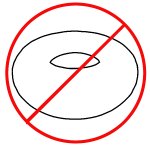
On the other hand, if at least one of the two factors is not homeomorphic to a circle, the resulting Cartesian product will not be homeomorphic to a torus. For example, the product of a circle and a line segment would not be a torus, since a line segment is not homeomorphic to a circle. 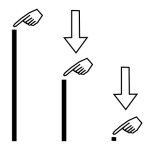 Observe, however, that a line segment can be continuously shrunken to a point (as in the diagram on the right). This operation of continously shrinking or expanding an object is called homotopy; and two objects that can be deformed in this manner to the same object are said to be homotopic. Thus we would say that a line segment is homotopic to a point; and consequently, the product of a line segment and a circle is homotopic to the Cartesian product of a point and a circle, which in turn is homeomorphic to a circle.
The 4D alphabet

We can play this game of taking the Cartesian product of two plane figures, not only with geometric figures, but with anything we would like -- the Roman alphabet, for instance. One finds that with the exception of products involving the capital letter B, all Cartesian products of two Roman alphabet letters are homotopic to either (1) one, two, or four points, (2) one or two circles, or (3) a torus! Consider, for example, the product of the letters d and p (as in DigiPen), which we shall dub the DigiTorus. Although not homeomorphic to a torus, the DigiTorus is homotopic to a torus, since both d and p are individually homotopic to a circle.
