To each their own torus

You are probably familiar with the donut shaped torus, at least with one of its usual embeddings in three-dimensional Euclidean space (pictured on the left). For the purposes of discussion, we will call this a standard torus. On the other hand, Mathematicians often find it more convenient to represent a torus as the Cartesian product of two circles: S x S, where S represents the unit circle in the plane. Let us dub this the Mathematicians torus.
Going from one to the other
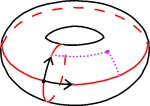
Although it is perhaps not a priori apparent that the Mathematicians torus is (topologically) the same as a standard torus, we can see that they are indeed essentially the same by introducing a coordinate system on the surface of a standard torus. We draw one large circle along the outermost rim of the torus, which we will call the longitudinal axis (akin to the equator on the surface of the Earth); and we draw one small circle that passes through the hole of the torus, which we will call the latitudinal axis (akin to the prime meridian passing through Greenwich, England). The two circles intersect at the origin of the coordinate system.
With this coordinate system, every point on the torus can then be represented by a pair of points, with each point a point on a circle (that is, by an element of S x S): the first is a point on the longitudinal axis giving the "longitude" of the point; the second is a point on the latitudinal axis giving the "latitude" of the point. 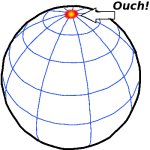 Note that on the surface of the Earth, the longitude/latitude coordinate system breaks down at the North and South Poles: longitude is no longer meaningful there. However, the longitude/latitude coordinate system on the surface of the torus does not suffer from this ailment: every point can be described uniquely by its coordinates, and every coordinate pair corresponds to a unique point on the surface of the torus. This gives us a one-to-one correspondence between points on the surface of the standard torus and points on the Mathematicians torus.
For more information: The Mathematicians torus (PDF document)
Wanted: another dimension
While it gives a simpler way of describing a torus, the Mathematicians torus does not "live" in three-dimensions, but rather in four-dimensions. A point on the unit circle S, which we think of as situated in the Cartesian plane, can be described by a coordinate pair, say (x,y), where
x2 + y2 = 1.
Thus a point in S x S is naturally described by a pair of coordinate pairs, say (x1,y1) and (x2,y2), where
x12 + y12 = 1
and
x22 + y22 = 1.
I.e., by the four coordinates (x1,y1,x2,y2). So a Mathematicians torus is most naturally embedded in four-dimensional space.
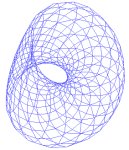
So what does a Mathematicians torus look like? To get a picture of it, we need to project from four-dimensions down to three. However, projection is not unique, just like casting a shadow of a three-dimensional object onto a wall: the shadow that we get depends on how you orient the object with respect to the wall, or equivalently, how you position the wall with respect to the object. To project the Mathematicians torus onto three-dimensions, one must choose a hyperplane, or three-dimensional subspace, in four-dimensional space onto which to project the torus. This amounts to choosing three (linearly independent) four-dimensional vectors, since they will span a three-dimensional subspace in four-dimensional space.
For more information: Projecting from four to three dimensions (PDF document)

