Geometry
(and other perversions)
One side for each dimension
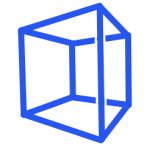
As creatures that inhabit three spacial dimensions, we are quite familiar with the cube: a box whose length, width, and height all have the same value. It is convenient to single out a special cube, the unit cube, whose sides all have unit length. The solid unit cube can be described as the set of points with coordinates (x,y,z) in space whose values are between 0 and 1:
0 ≤ x ≤ 1,
0 ≤ y ≤ 1,
0 ≤ z ≤ 1.
With this description, it is easy to generalize the notion of the unit cube to any dimension desired: one simply adds a coordinate, taking values between 0 and 1, for each available dimension. Bear in mind, however, when we draw a cube, we typically only draw the edges of cube, since it is difficult to indicate the insides and faces of the cube in a simple line drawing.

In particular, a one-dimensional unit cube is a line segment of unit length:
0 ≤ x ≤ 1.
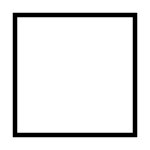
Similarly, a two-dimensional unit cube is a unit square:
0 ≤ x ≤ 1,
0 ≤ y ≤ 1.
Again, note that the square pictured here only has the edges drawn. Incidentally, one may also define a zero-dimensional cube to be a single point.
The hypercube
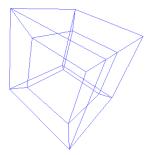
The four-dimensional version of a cube is called a hypercube, or sometimes tesseract. According to the above description, points in the solid unit hypercube are described by four-tuples (w,x,y,z) such that
0 ≤ w ≤ 1,
0 ≤ x ≤ 1,
0 ≤ y ≤ 1,
0 ≤ z ≤ 1.
To get a view of a hypercube, we may project (say orthogonally) its edges onto three dimensions. One such projection is pictured on the left in a two dimensional perspective line drawing.
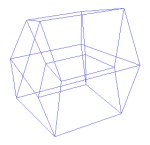
There are many way in which we can project from four to three dimensions, and each choice of projection may yield a radically different view of the hypercube. Indeed, the image on the right is another two dimensional perspective line drawing of the same hypercube, but using a different (orthogonal) projection.
For more information on how to find the edges (and other things) of an arbitrary dimensional cube: Specifying a cube in any dimension (PDF document)
For more information on projecting from four to three dimensions: Projecting from four to three dimensions (PDF document)
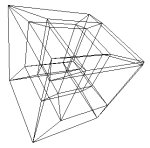
Of course, we can keep playing this game for as long as we like: we can construct higher dimensional cubes by adding on more dimensions. For example, the five-dimensional unit cube would consist of the points with coordinates (v,w,x,y,z) such that
0 ≤ v ≤ 1,
0 ≤ w ≤ 1,
0 ≤ x ≤ 1,
0 ≤ y ≤ 1,
0 ≤ z ≤ 1.
On the other hand, to get a glimpse of such an object, we would have to project onto three dimensions -- loosing much information in the process. For example, with the five-dimensional cube, we would have to drop two dimensions to get to three-dimensions; for comparison, imagine projecting a cube onto a line: most of the information about the cube is lost. The jumble of lines pictured above is just what we might get by projecting the five-dimensional unit cube onto three-dimensions (and then making a perspective projection to make a two-dimensional line drawing).
Other points of view
Here is a link to a graphical program for viewing low-dimensional cubes.
 |
Three, four, and five dimensional cubes rotating |
Copyright © 2016 by Jason Hanson and DigiPen Institute of Technology