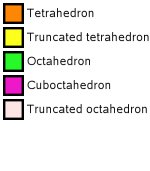
In brief. The window below shows various Platonic and Archimedean solids which possess achiral tetrahedral symmetry, which extends tetrahedral symmetry. The controls are the same as with the tetrahedral symmetry graphical program.
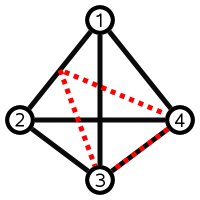
Recall that the generators of the tetrahedral symmetry group can by described by the vertex permutations a = (1,2)(3,4) and b = (1,2,3). The vertex permutation r = (1,2) corresponds to reflection in the plane containing the vertices 3 and 4, and the midpoint between vertices 1 and 2 (the plane containing the red triangle in the image on the left). We had removed this reflection from consideration previously, since a reflection does not preserve orientation (left becomes right and vice versa). However if we choose to allow reflectional symmetry, then the symmetry group will now have generators a, b, and r. It turns out that the resulting group, the achiral (or full) tetrahedral symmetry group, has 24 elements (twice the size of the tetrahedral symmetry group), and is actually S4, the symmetric group on four letters: the group of all possible permutations of the sequence [1,2,3,4].
It is more convenient to express the achiral tetrahedral symmetry group in terms of different generators, namely
r = (1,2), s = (1,2,3,4).
In fact, we see that a and b can be expressed in terms of r and s:
(1,2)(3,4) = a = rs2rs2 = (1,2) (1,2,3,4)(1,2,3,4) (1,2) (1,2,3,4)(1,2,3,4)
and
(1,2,3) = b = s3rs2 = (1,2,3,4)(1,2,3,4)(1,2,3,4) (1,2) (1,2,3,4)(1,2,3,4)
(as the reader will verify).
In terms of our matrix representation of the tetrahedral symmetry group (as given on the tetrahedral symmetry page), we may take
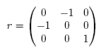 |
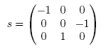 |
as the matrices representing r and s. You are invited to verify that these matrices act on the points v1, v2, v3, and v4 in the advertised way.
As with the matrix representation of the tetrahedral symmetry group, we may interpret the achiral tetrahedral symmetry group as acting on the unit sphere. By choosing an initial vertex, its orbit under the group action gives the vertices of a solid. In the above applet, the small window on the left allows you to choose the initial vertex, and the window on the right gives you the solid which results.
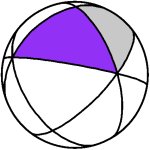
The (chiral) tetrahedral symmetry group, which has 12 elements, is a subgroup of the achiral tetrahedral symmetry group, which has 24 elements. This means that while only 12 copies of the fundamental region of the tetrahedral symmetry group are needed to tile the sphere, 24 copies of the fundamental region of the achiral tetrahedral symmetry group are needed. In fact, we may take the fundamental region of the achiral tetrahedral symmetry group to be half of the fundamental region for the tetrahedral symmetry group. In the image on the right, the fundamental region of the achiral tetrahedral symmetry group is indicated in purple, while the fundamental region of the (chiral) tetrahedral symmetry group is the union of the purple region and the light gray region. For programming reasons (and for consistency among the applets), the fundamental region of the achiral tetrahedral symmetry group (the purple region) is depicted in the above applet as a square instead of a triangle (the dividing line was chosen essentially arbitrarily).
On the tetrahedral symmetry application page, the special points of the fundamental region of the tetrahedral symmetry group (the points corresponding to the tetrahedron, truncated tetrahedron, et cetera) have reflectional symmetry with respect to the line dividing the fundamental region in half. This is due to the fact that the (chiral) tetrahedral symmetry group is not the full tetrahedral symmetry group, as reflections are not used. In contrast, the fundamental region of the achiral tetrahedral symmetry group does not have such symmetry: the truncated octahedron point within the fundamental region lacks a mirror image; this "reflects" (so to speak) the fact that no more symmetries are to be had. Thus the fundamental region of the achiral tetrahedral symmetry group is truly fundamental.
Other tetrahedral symmetries:
Copyright © 2016 by Jason Hanson and DigiPen Institute of Technology