Geometry
(and other perversions)

DigiPen main page Geometry main page Platonic solids page

Tetrahedral symmetries
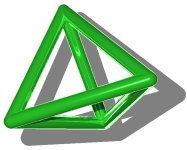
tetrahedron

The Tetrahedral symmetry group, denoted by T4, is the finite group with 12 elements generated by the symbols a and b, subject to the three relations

a2 = e,   b3 = e,   (ab)3 = e,

where e is the identity element.  In terms of cycle notation, we can also represent the tetrahedral symmetry group by the permutations

a = (1,2)(3,4),   b = (1,2,3).

That is, we can view a and b as the permutations of the sequence [1,2,3,4] given by a([1,2,3,4]) = [2,1,4,3] and b([1,2,3,4]) = [2,3,1,4].  Note that these permutations reproduce the relations stated above; e.g., a2 = (1,2)(3,4)(1,2)(3,4) = () = e.  Since we may also write b = (1,3)(1,2), we see that both a and b are even permutations; in fact, tetrahedral symmetry group is none other than the alternating group on four letters, which Mathematicians denote by A4

See the document Groups and permutations for more information on generators and relations, as well as cycle notation.
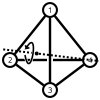
tetrahedron - labels

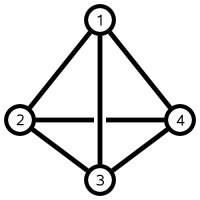
To illustrate the connection between the abstract tetrahedral symmetry group and Platonic and Archimedean solids, let us label the vertices of the tetrahedron as 1,2,3,4, as in the figure on the right.  The generator a = (1,2)(3,4) amounts to rotating the tetrahedron by 180 degrees about the axis passing through the midpoint between vertices 1 and 2, and the midpoint between the vertices 3 and 4.  The generator b = (1,2,3) corresponds to rotation by 120 degrees about the axis passing through vertex 4 and the center of the face formed from vertices 1, 2, and 3.
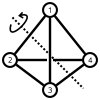
a - axis b - axis

You may be wondering about the permutation that swaps vertices 1 and 2, while leaving vertices 3 and 4 unchanged; i.e., the cycle (1,2).  This corresponds to a reflection through the mirror plane that contains the vertices 3 and 4, and the midpoint of the edge between vertices 1 and 2.  Since reflections reverse orientation, while rotations preserve orientation, the cycle (1,2) is sometimes left out.  We will discuss this later when we discuss the so-called full tetrahedral symmetry group, also known as the achiral tetrahedral symmetry group.
Matrix representation

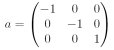
As we have indicated, the generators a and b of the tetrahedral symmetry group correspond to rotations in three dimensional space.  Rotations, in turn, are conveniently expressed in terms of 3 x 3 matrices.  In particular, let us take the vertices of the tetrahedron to be the points

v1 = (1,1,1),   v2 = (-1,-1,1),   v3 = (1,-1,-1),   v4 = (-1,1,-1).

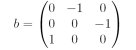
These points are chosen to make the rotation matrices particularly nice: in this case,

a - rotation b - rotation

give matrix representations for the generators a and b.  Indeed, one computes that a2 = I, b3 = I, and (ab)3 = I, where I is the identity 3 x 3 matrix, so that the above matrices give another way of representing the tetrahedral symmetry group.  Moreover, av1 = v2, av3 = v4, bv1 = v2, bv2 = v3, bv3 = v1, and bv4 = v4, so that the matrices act on the vertices in the manner described above.

For a review of matrices and matrix multiplication, as well as for more information on representing groups with matrices, see the document Matrix representations.

Other solids with tetrahedral symmetry

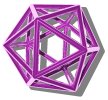
icosahedron

The symmetry group for the icosahedron contains the tetrahedral symmetry group; that is, T4 is a subgroup of the icosahedral symmetry group.  So in this sense, the icosahedron has tetrahedral symmetry; and in fact, every other Platonic and Archimedean solid has T4 as a subgroup of its symmetry group, hence possess tetrahedral symmetry.  However, with the exception of the truncated tetrahedron (see below) and the tetrahedron, all Platonic and Archimedean solids have symmetry groups that are larger than the tetrahedral symmetry group.

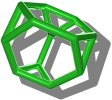
truncated tetrahedron

The truncated tetrahedron, as its name implies, can be constructed from the tetrahedron by slicing off the corners of a tetrahedron.

cutting a tetrahedron arrow truncated tetrahedron

At each vertex of the truncated tetrahedron, there are two hexagons and one triangle.

Tetrahedral symmetries in action

The following are links to other pages which contain graphical programs that visually demonstrate the tetrahedral symmetry group and its variants.

Copyright © 2016 by Jason Hanson and DigiPen Institute of Technology