Geometry
(and other perversions)
Platonic solids
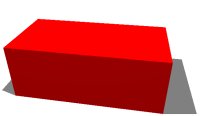
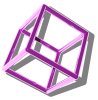
We are all familiar with the box; it permeates our everyday lives. It is the shape of doors, books, rooms, and buildings; we pack our stuff into them. Humans have a preference for boxes since they are easy to construct: six rectangles pasted together. Of all types of boxes, the cube is the most sacred, since it has sides of equal length; that is, its sides are composed of six squares, all of equal size. A cube exhibits a high degree of symmetry. Not only are all of its sides formed from squares of the same size, but all vertices (corners) of the cube are identical, in that they are all formed from the corners of exactly three squares.
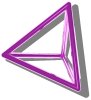
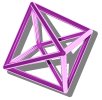
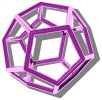
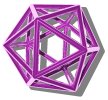
A Platonic solid is the generalization of a cube. It is a three-dimensional solid, the sides of which are all copies of a single given regular polygon (that is, a polygon with equal sides and angles), and whose vertices are all identical. Curiously enough, there are only five Platonic solids: tetrahedron, cube, octahedron, dodecahedron, and icosahedron.
That these are the only Platonic solids is not difficult to see. A regular (equilateral) triangle has angles of 60 degrees. Since 3 x 60 = 180, 4 x 60 = 240, and 5 x 60 = 300 are all less than 360 degrees, we can construct Platonic solids using 3, 4, or 5 triangles at one vertex: namely, the tetrahedron, octahedron, and icosahedron.
Observe that 6 x 60 = 360, so that putting 6 triangles at one vertex gives a planar figure, and so cannot be a vertex of a solid; it is not possible to put more than 6 triangles together at one vertex, since we only have 360 degrees to play with. Similarly, the reader will verify that it is possible to have only 3 squares (angles of 90 degrees) at a vertex: a cube, and only 3 regular pentagons (angles of 108 degrees) at a vertex: a dodecahedron.
It is not possible to have 3 regular hexagons (angles of 120 degrees) at a vertex, nor have 3 of any other regular polygon at a vertex.
Archimedean solids
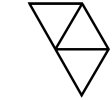
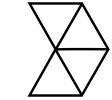
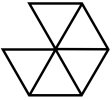
By relaxing the restriction that all faces must be the same regular polygon, we obtain other symmetric solids: the Archimedean solids. That is, an Archimedean solid has faces formed from regular polygons and has identical vertices. The Archimedean solids may be constructed in essentially the same way as with Platonic solids. For example, each vertex of the cuboctahedron is surrounded by two squares and two triangles:
In total, there are thirteen Archimedean solids. We will meet up with the other twelve a little later.
Symmetry groups
The requirement that all vertices of a Platonic or Archimedean solid be the same means that such a solid possesses symmetries: it looks the same from several different angles. In Mathematics, one uses a group to abstract the notion of symmetry. Formally, a group is a set G containing a special element e (the identity element), and has a binary operator ∗ (with we can think of as something akin to multiplication) such that
- g ∗ (h ∗ k) = (g ∗ h) ∗ k,
- e ∗ g = g and g ∗ e = g,
- for every g in G, there exists an element g-1 in G with g ∗ g-1 = e = g-1 ∗ g.
That is, the operation ∗ behaves like normal multiplication, the element e behaves like the number 1, and every element has a multiplicative inverse. Indeed, the nonzero real numbers form a group under multiplication of reals.
As a simple example of a group used to encode symmetry, let C5 denote the set of powers of the symbol r up to 4: r0 = e, r1 = r, r2, r3, r4. Multiplication in C5 is defined by the rule
rm ∗ rn = r(m+n) mod 5.
Here, the addition of exponents is modulo 5: find the remainder of (m + n) divided by 5. E.g., r3 ∗ r4 = r2, since (3 + 4)/5 = 7/5 = 1 R 2. Note that r5 = e, and the inverse of rm is rn, where n is the additive complement of m with respect to 5; i.e., m + n = 5. For example, (r3)-1 = r2, since 3 + 2 = 5.
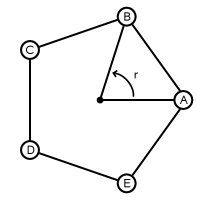
The group C5 describes the symmetries of a regular pentagon. If we label the vertices by A, B, C, D, E, as pictured to the right, we may regard rm as rotation by m x 72 degrees about the center of the pentagon. That is, the vertex A is mapped to the vertex B under r, to C under r2, and so on around the pentagon until A is mapped to itself by r5 = e. Similarly, the vertex B is mapped to the vertex C under r, to D under r2, et cetera.
Here is some more information about groups: Groups and permutations.
Platonic and Archimedean solids by symmetry group
Each Platonic and Archimedean solid has an associated group that describes its symmetries. However, not all the symmetry groups are distinct: there are distinct solids that possess the same symmetry group; for example, the cube and the octahedron have the so-called octahedral group as symmetry group. It turns out that there are in fact only five symmetry groups for all eighteen Platonic and Archimedean solids; moreover, two of these groups are similar enough to the other three that one typically says there are only three main symmetry groups.
Below are links to pages describing in gruesome detail each of the main symmetry groups of the Platonic and Archimedean solids, and include some amusing graphical programs.
 |
Tetrahedral symmetries |
 |
Octahedral symmetries |
 |
Icosahedral symmetries |
Copyright © 2016 by Jason Hanson and DigiPen Institute of Technology