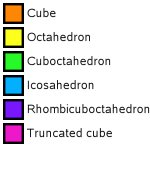
In brief. The applet below shows various Platonic and Archimedean solids which possess pyritohedral symmetry, which gives another distinct extension of tetrahedral symmetry. The program controls are the same as with the tetrahedral symmetry applet.
The (chiral) tetrahedral symmetry group T4 is a subgroup of the full (achiral) tetrahedral symmetry group S4; in fact it is a normal subgroup, so that the cosets S4/T4 form a group. Specifically, we may divide S4 into the two subsets:
p = T4 = {e, (1,2,3), (1,3,2), (1,2,4), (1,4,2), (1,3,4), (1,4,3), (2,3,4), (2,4,3), (1,2)(3,4), (1,3)(2,4), (1,4)(2,3)}
andq = (1,2)T4 = {(1,2), (1,3), (1,4), (2,3), (2,4), (3,4), (1,2,3,4), (1,2,4,3), (1,3,2,4), (1,3,4,2), (1,4,2,3), (1,4,3,2)}
(that is, q consists of the elements of S4 of the form (1,2)x, where x is from T4). Using the multiplication on S4, we may define the product of two subsets: if A and B are subsets, we define A∗B to be the set of all elements in S4 of the form ab, where a is from A and b is from B. Using this definition, we find that
p∗p = p, p∗q = q, q∗p = q, q∗q = p,
as the reader will verify. I.e., {p,q} forms a group which is isomorphic to C2, the cyclic group of order 2, where p acts as the identity element.
For more information about cosets and normal subgroups, see the document: Cosets and group actions.
We may summarize what we have just found in terms of the exact sequence of group homomorphisms
1 --> T4 --> S4 --> C2 --> 1.
Here 1 denotes the trivial group consisting of only the identity element. The map on the left (1 --> T4) sends the identity to the identity, and the map on the right (C2 --> 1) sends all elements to the identity. The second map from the left (T4 --> S4) is the inclusion map. The third map (S4 --> C2) sends the permutation g to the subset gT4. The reader may verify that all of these maps are indeed group homomorphisms. The adjective exact used to describe the above sequence of maps means that the image of any map is equal to the kernel of the next, the kernel of a homomorphism being the set of all elements that map to the identity. In particular, for the above sequence to be exact, we must have that the map S4 --> C2 be surjective (onto), and its kernel be equal to T4.
In general, given a group H, if there exists groups G, K and an exact sequence
1 --> H --> G --> K --> 1,
we say that G is an extension of H by K. [Warning: some Mathematicians say in this situation that G is an extension of K by H.]
More information about exact sequences and group extensions can also be found in the document Cosets and group actions.
We can write down another extension of T4 by C2, which is in some sense simpler than the one given above. Namely, we take G to be the direct product
G = T4 x C2
of all pairs (g,c) with g from T4 and c from C2. By taking T4 --> G to be the inclusion map that sends g to (g,e), and G --> C2 to be the projection map which sends (g,c) to c, we get an exact sequence
1 --> T4 --> G --> C2 --> 1
of groups. That is, G is indeed another extension of T4 by C2, which is called the pyritohedral symmetry group. It turns out that these are essentially the only two extensions of T4 by C2 that are possible.
Generators for the direct product T4 x C2 as a permutation group may be taken to be
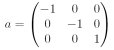
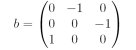
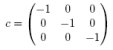
a = (1,2)(3,4), b = (1,2,3), c = (5,6).
That is, we augment the list of permutations of T4 by the permutation (5,6). To obtain a matrix representation, we simply take the cycle (5,6) to be multiplication by -1 (reflection through the origin):
 |
 |
 |
As with the chiral and achiral tetrahedral symmetry groups, we can use this matrix representation to define an action on the unit sphere.
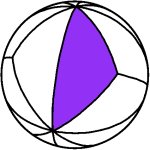
The window at the top of the page shows the polyhedron whose vertices are obtained from the orbit of a chosen point on the unit sphere under this group action. The initial point on the sphere is chosen from the fundamental region of the pyritohedral symmetry group action, pictured in purple on the image to the left, and which is represented by the smaller window on the left-hand side of the applet (as with the achiral tetrahedral symmetry group applet, the fundamental region is -- somewhat arbitrarily -- divided into two regions). Notice that pyritohedral symmetry group is not a symmetry group of the tetrahedron, since the tetrahedron is not symmetric under the antipodal map: the map which sends a point to its antipode, the point on the opposite side of the sphere (the North and South Poles of the Earth are antipodal points).
Other tetrahedral symmetries:
Copyright © 2016 by Jason Hanson and DigiPen Institute of Technology