Icosahedral symmetries
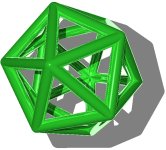
The icosahedral symmetry group, which governs the symmetries of both the icosahedron and the dodecahedron, can be described as the abstract group on two generators p, q subject to the relations
p2 = e, q5 = e, (pq)3 = e.
A permutation representation of this group is given by
p = (1,2)(3,4), q = (1,2,3,4,5).
In fact, this group is none other than the alternating group on five letters, denoted by A5, and which contains 60 elements.
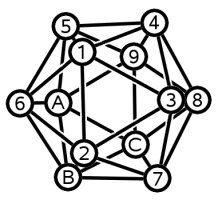
It is possible, as we did with the octahedral symmetry group (see the octahedral symmetry page), to write down other permutation representations that explicitly indicate the vertex permutations of the icosahedron and dodecahedron. For instance, with the vertices of the icosahedron labeled as in the figure on the right, the generators of the icosahedral symmetry group would be
p' = (1,4)(2,9)(3,5)(6,8)(7,A)(B,C),
q' = (2,3,4,5,6)(7,8,9,A,B).
That is, p' corresponds to rotation by 180 degrees about the axis passing through the midpoint of the edge with vertices 1 and 4, and the midpoint of the edge with vertices B and C; similarly, q' corresponds to rotation by 72 degrees about the axis passing through vertices 1 and C.