Octahedral symmetries
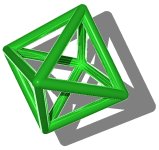
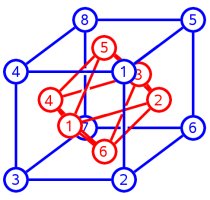
The symmetry groups of the octahedron and the cube are both the same, namely the octahedral symmetry group, which is actually none other than the symmetric group on four letters. We have already encountered this group as the full (achiral) symmetry group of the tetrahedron (see the achiral tetrahedral symmetry page). It has generators r and s, subject to the relations
r2 = e, s4 = e, (rs)3 = e, (rs2)4 = e. [eq 1]
We know that as a permutation group, this group is generated by
r = (1,2), s = (1,2,3,4). [eq 2]
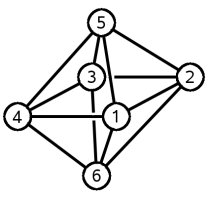
One drawback of the permutation representation of the octahedral symmetry group given in [eq 2] is that it does not immediately indicate how the vertices of either the octahedron or cube are affected by a group element. A different permutation representation of the symmetric group on four letters that does give the group action on the vertices of the octahedron is
r' = (1,2)(3,4)(5,6), s' = (2,6,4,5). [eq 3]
Note that r' and s' given here indeed satisfy the abstract relations in [eq 1] above, so that the permutation groups generated by r',s' and r,s are both isomorphic to the same group. Geometrically, r' is a rotation by 180 degrees about the line passing through the center of edge with vertices 1,2 and through the center of the edge with vertices 3,4; and s' is rotation by 90 degrees about the line passing through the vertices 1 and 3. Curiously enough, r' is a rotation, unlike in the case of tetrahedral symmetry where it is a reflection; we will say more about this when we discuss matrix representations of the octahedral symmetry group.
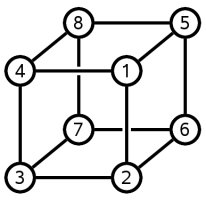
Similarly, if we may write down a permutation representation of the symmetric group on four letters that indicates the group action on the vertices of the cube. If we label the vertices of the cube as in the picture on the left, we have
r'' = (1,2)(3,5)(4,6)(7,8),
s'' = (1,2,3,4)(5,6,7,8).
[eq 4]
Again, one verifies that r'',s'' satisfy the abstract relations in [eq 1], and so we obtain another group isomorphic to the octahedral symmetry group. In this case r'' is rotation by 180 degrees about the line passing through the midpoint of edge with vertices 1,2 and the midpoint of the edge with vertices 7,8; s'' is rotation by 90 degrees about the line passing through the center of the faces with vertices 1,2,3,4 and the face with vertices 5,6,7,8.