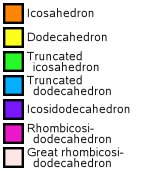
In brief. The window below shows various Platonic and Archimedean solids which possess achiral icosahedral symmetry. The controls are the same as with the tetrahedral symmetry program.
As with the achiral octahedral symmetry group, the achiral (or full) icosahedral symmetry group is formed as a direct product of the (chiral) icosahedral symmetry group with the cyclic group of order two: A5 x C2. As an abstract group, this is obtained by adding on a generator t of order 2 that commutes with the generators p,q of the icosahedral symmetry group:
p2 = e,
q5 = e,
(pq)3 = e,
t2 = e,
tp = pt,
tq = qt.
The simplest permutation representation of this group is obtained by adding the cycle (6,7) to the permutation representation given at the top of the icosahedral symmetry page; i.e.,
p = (1,2)(3,4), q = (1,2,3,4,5), t = (6,7).
The achiral icosahedral symmetry group has 120 elements.
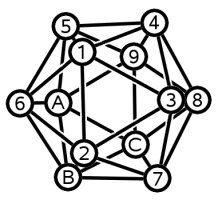
Another permutation representation of the achiral icosahedral symmetry group that indicates the how the vertices of the icosahedron are permuted by the group is given by
p' = (1,4)(2,9)(3,5)(6,8)(7,A)(B,C),
q' = (2,3,4,5,6)(7,8,9,A,B),
t' = (1,C)(2,9)(3,A)(4,B)(5,7)(6,8).
Again, as with the achiral octahedral symmetry group, the generator t acts as inversion: reflection through the center of the icosahedron.
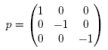
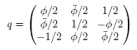
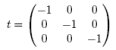
Also as with the achiral octahedral symmetry group, we obtain a matrix representation of the achiral icosahedral symmetry group from the chiral one by having the generator t act antipodally; that is, multiplication by -1:
 |
 |
 |
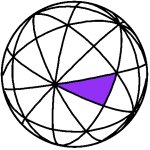
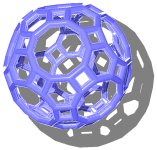
The fundamental region for the corresponding group action on the unit sphere is shown in the image on the left; it is one half of the fundamental region for the chiral icosahedral symmetry group (see the icosahedral symmetry demo page). The program at the top of the page allows you to choose a point inside the fundamental domain (arbitrarily divided into two halves in the window on the top left of the page); the solid with vertices obtained from the orbit of the chosen point is shown in the window on the top right of the page.
In addition to the direct product extension A5 x C2, the icosahedral symmetry group has another extension by C2, namely the symmetric group on five letters S5; i.e., we have an exact sequence of groups
1 -> A5 -> S5 -> C2 -> 1
This extension is similar to the extension of the tetrahedral symmetry group T4 to S4, as discussed on the achiral tetrahedral symmetry page. Curiously enough however, the symmetric group on five letters is not the symmetry group of any Platonic (or Archimedean) solid; in fact, there are no irreducible matrix representations of dimension three for this group, so we cannot play the same game of letting the group act on the surface of the unit sphere in two dimensions (without going to higher dimensions, that is).
On the other hand, the icosahedral symmetry group has another distinct matrix representation in addition to the one given on the icosahedral symmetry demo page. Namely, we may take
|
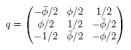 |
as our matrix representation of the icosahedral symmetry group. Although the matrix for p is the same for both representations, the matrix for q is different: for the original representation given on the icosahedral symmetry demo page, q corresponds to rotation by 72 degrees, while in the above representation, q corresponds to rotation by 144 degrees. If we use this matrix representation to give an action of the icosahedral symmetry group on the unit sphere, the solids with vertices formed from the orbits will look exactly like those of formed from our original representation, even though the two representations are non-isomorphic (distinct).
Other icosahedral symmetries:
Copyright © 2016 by Jason Hanson and DigiPen Institute of Technology