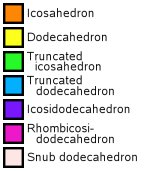
In brief. The window below shows various Platonic and Archimedean solids which possess icosahedral symmetry. The controls are the same as with the tetrahedral symmetry program.
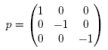
A matrix representation for the icosahedral symmetry group, which gives the rotations corresponding to p' and q' from the icosahedral symmetry page, is given by
 |
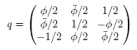 |
where φ = (1 + √5)/2 is the golden ratio, and φ with a bar (line) over it is (√5 - 1)/2, the conjugate of the golden ratio.
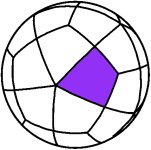
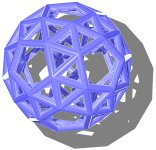
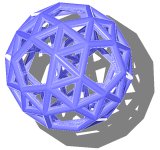
Using the matrix representation given above, we get an action of the (chiral) icosahedral symmetry group on the unit sphere. The fundamental region of this action is shown in the figure on the left. The window on the left above allows you to chose a point in the fundamental region; the orbit of this point under the group action gives the vertices of the solid figure depicted in the window on the right above. As with the tetrahedral and octahedral symmetry groups, the fundamental region is naturally divided into two triangular regions which arise from reflectional symmetries. And as with the snub cube from the (chiral) octahedral symmetry group, the snub dodecahedron comes in two flavors: dextro and laevo.
 |
 |
As with the octahedral symmetry group, we can extend the icosahedral symmetry group by C2 to obtain the full (achiral) icosahedral symmetry group.
Copyright © 2016 by Jason Hanson and DigiPen Institute of Technology