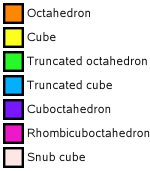
In brief. The window below shows various Platonic and Archimedean solids which possess octahedral symmetry. The applet controls are the same as with the tetrahedral symmetry programs.
As with the tetrahedral symmetry group, there is a matrix representation of the symmetric group on four letters that gives the symmetries of the octahedron and cube mentioned on the octahedral symmetry group page. In fact, one verifies that the matrices
 |
 |
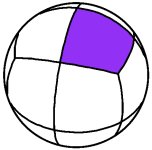
satisfy the abstract group relations in [eq 1] on the octahedral symmetry group page. Moreover, if we set u1 = (1,0,0), u2 = (0,1,0), u3 = (-1,0,0), u4 = (0,-1,0), u5 = (0,0,1), and u6 = (0,0,-1), then the matrices of r and s give the vertex permutations of the octahedron indicated in [eq 3] on that page. We can use this matrix representation of the octahedral symmetry group to act on the unit sphere, in much the same way as we did with the tetrahedral symmetry group. The fundamental region of this action is show as the purple rectangular region in the image on the left; and the applet at the top of the page shows what happens when choose a point in the fundamental region and use the orbit of that point to obtain the vertices of a solid.
On the other hand, the matrix representation used here is different from that used for the achiral (full) tetrahedral symmetry group (which is the same group, namely the symmetric group on four letters, given on the achiral tetrahedral symmetry page). The difference between the two representations is not merely a cosmetic sign change in matrix elements; the two representations are inequivalent: they give two distinct irreducible representations of the symmetric group on four letters (and in fact, there are only two three-dimensional irreducible representations of this group). Geometrically, the distinction between these two representation is born out by the difference in fundamental domains, as well as in the distinct (albeit overlapping) sets of Platonic and Archimedean solids generated by the two.
For more information on irreducible representations, see the document Matrix representations.
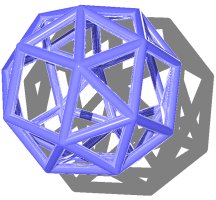
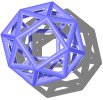
There two points within the interior of the fundamental region of the octahedral symmetry group that generate the vertices of the snub cube. A similar phenomenon occurs for the tetrahedral symmetry group: there are two points within the interior of the fundamental region for the tetrahedral symmetry group whose orbits are the vertices of the icosahedron (see the tetrahedral symmetry applet page); for this reason the icosahedron is sometimes referred to as a snub tetrahedron. Upon closer inspection however, unlike with the two icosahedra generated, the two snub cubes are actually different. If we look directly at a square face of a snub cube, the face oppose this face is also a square, but rotated. Comparing the two snub cubes generated by the two points in the fundamental region, we see that although the rotation angle is the same, the direction of rotation is different for each:
 |
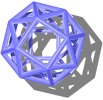 |
The snub cube on the left is called a laevo snub cube, and the one on the right is called a dextro snub cube; each is the mirror image of the other.
Copyright © 2016 by Jason Hanson and DigiPen Institute of Technology