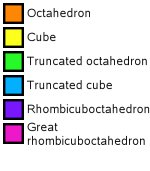
In brief. The applet below shows various Platonic and Archimedean solids which possess achiral octahedral symmetry. The applet controls are the same as with the tetrahedral symmetry applet.
The simplest, and in fact the only, group extension of the octahedral symmetry group S4 by C2 is the direct product S4 x C2, which is called the achiral (or full) octahedral symmetry group. As an abstract group, we simply introduce a new generator t that commutes with those of the (chiral) octahedral symmetry group (as given in [eq 1] on the octahedral symmetry page) and whose square is the identity:
r2 = e,
s4 = e,
(rs)3 = e,
(rs2)4 = e,
t2 = e,
rt = tr,
st = ts.
[eq 1']
As we did with the pyritohedral symmetry group (see the pyritohedral symmetry page), we obtain a permutation representation of this abstract group by introducing the cycle (5,6):
r = (1,2), s = (1,2,3,4), t = (5,6).
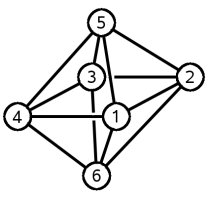
However, we may gain more geometric insight by extending the permutation representation of the octahedral symmetry group given in [eq 3] on the octahedral symmetry page:
r' = (1,2)(3,4)(5,6),
s' = (2,6,4,5),
t' = (1,3)(2,4)(5,6).
[eq 3']
Indeed, r', s', t' satisfy the abstract group relations in [eq 1']. That is, t corresponds to inversional symmetry: each vertex is mapped into its antipode under t. In contrast to the tetrahedron, which does not have inversional symmetry, both the octahedron and cube enjoy such symmetry. This is reflected in the fact that the full tetrahedral symmetry group is not a direct product extension of the tetrahedral symmetry group, while the full octahedral symmetry group is a direct product extension of the octahedral symmetry group.
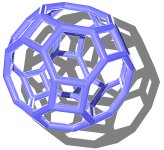
On the other hand, the snub cube (either the dextro or laevo version), which is the "generic" solid for octahedral symmetry, does not have inversional symmetry. The snub cube then cannot be the "generic" solid for the full (achiral) octahedral symmetry; this solid is in fact the great rhombicuboctahedron, which does possess inversional symmetry.
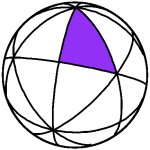
Since we are extending the octahedral symmetry group by a direct product with the cyclic group of order two, the matrix representation is obtained by letting the abstract generator t act by the antipodal map; i.e., multiplication by -1:
 |
 |
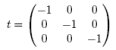 |
(the reader will verify that these satisfy the abstract group relations in [eq 1']). The applet at the top of the page shows the result of letting this matrix representation for the achiral (full) octahedral symmetry group act on the unit sphere. The fundamental region of this action is depicted in the image on the left; it is half of the fundamental region of the (chiral) octahedral symmetry group (see the octahedral symmetry demo page). The dividing line shown in the smaller applet window above, which represents the fundamental region, was chosen more-or-less arbitrarily.
Other octahedral symmetry:
Copyright © 2016 by Jason Hanson and DigiPen Institute of Technology